Thursday, July 25, 2013

Thought of the Week - 23rd July

This week I was thinking about the omnipresence of masks on the Greek stage. In Greek Drama, every single actor wears a mask and no person other than the Aulos Player is allowed to be present on stage without a mask on. Now I didn't really attach too much significance to the presence of the masks before this week. I had always known that Greek actors always had to wear masks of stiffened linen which always had the same expression on it. For me, the interesting thing about the presence of the masks was the skill that must have been required in the actors to successfully portray a range of emotions from behind the mask. They must really have relied heavily on voice modulations and subtle changes in body language to have been good enough to draw crowds of thousands to their performances. But this week, I came across some vase paintings that showed the stark dichotomy between mask-on and mask-off that got me thinking. I had seen many of these vase paintings before as part of a course I had taken in university but then I had been worried more about memorising the specifics of the paintings than taking in the significance of what they portrayed. Now, in the leisure of the summer, I had the time to actually look at the paintings and think about why the ancient Greeks portrayed masks so purposefully and carefully in such artifacts.

One of the vase paintings that I studied is represented below. It is called the Pronomos vase and it is one the most famous and valuable (information-wise) vase paintings related to the Greeks that has been found. It represents the FULL cast of an ancient Greek Satyr Play and therein lies it's significance. Other vases show excerpts from the casts of plays or scenes from the play itself but the fact that this vase shows the entire cast of the play is astounding and infinitely useful for classicists. I may go into a full discussion about the Pronomos vase in a future post but as far as this post is concerned, I only have to mention that the vase painting shows some of the actors with their intricately painted masks off and in their hands and some with their masks still on. The actors with the masks off are thus themselves while the masks represent their characters. For the ancient Greeks, the masks were the line between reality and fantasy, the characters and the actors. As can be seen below, all the actors depicted on the Pronomos vase with their masks on are all in character (one that of a Satyr: part of a chorus of Satyrs, and the others speaking characters) and are dancing or striking wild poses while the actors with their masks off are casually lounging about: clearly human beings and not Satyrs. It is of some importance to note here that the only people without masks on the vase are the Aulos player in the center and the two divinities watching the play right above him: Dionysus and Ariadne.

The Pronomos Vase

This explains, perhaps, why all the characters in Greek Drama were masked.

Wednesday, July 10, 2013

Thought of the Week - 10th July

This week I abandoned the notion that the ancient Greek civilization was a continuous civilization all the way from the late Bronze Age to the Hellenistic period, at least in the minds of the ancient Greeks. It seems like an absurd thing to have thought but I had never really considered the Greeks of the classical period as 'other' than the Greeks of the archaic period. They were the same people in my mind even though I knew that the culture, politics, technology and everything else had changed around them. I had this epiphany while reading the opening chapter of the first book of Thucydides' A History of the Peloponnesian War' where he gives a summary of the history of Greece from the pre-Mycenaean period to the classical period when he was writing. Since the actual history of the Peloponnesian war really starts from chapter two, I had always skipped this chapter before. But this afternoon, bored and finding nothing else to do, I gave it a read and was surprised to find Thucydides obviously treating the ancient-er Greeks as 'other' to himself. That chapter clearly has an 'us vs. them' feel to it similar to something one could find in a history book today which talks about the Romans. After giving it some thought, I realized that the Mycenaeans Thucydides was talking about lived a thousand years before him. Other than geography, there was no reason for him to think of them as continuous people. Upon reflection, I found that I myself didn't really think of the generation that lived through the first world war as a continuous people of which I was a part. The second world war, yes, but not the first. I think that has something to do with the fact that I have never really known anybody who lived through the first world war. My grandparents were alive during the second and I could talk to them about it but I couldn't have ever talked to anyone about how it felt to have lived through the first. So basically, do we innately disown the people who are out of living memory for us and relegate them to cold history instead of warm human-ness? Do we, as humans, thus always only have a fixed period of time which we consider as 'us' and so everyone predating 'us' becomes 'them'? Will I, sixty years down the line, become a 'them'?

Monday, July 08, 2013

The Choral Ode in Sophocles' Oedipus at Colonus: Part 2

[Please Note: This post is a continuation from the previous post titled 'The Choral Ode in Sophocles' Oedipus at Colonus: Part 1'. In order for a coherent reading, please peruse that post before reading this one.]

The next part of the ode is, like the Dionysus reference, symbolic of life after death and hope in destruction. The chorus sings of the burial flowers: the narcissus and the crocus. These flowers were commonly used by the ancient Greeks in burial rites and rituals. So by saying that the Athenian land was covered with these flowers, Sophocles is telling us that these lands are ready for burial. However, the flip side of the narcissus and the crocus imagery is that these flowers were sacred to the goddess Persephone and her mother Demeter. Demeter and Persephone are the very personifications of the cycles of life and death. The chorus sings about them ("the mother and daughter twine") and dedicates the flowers and the lands of Athens to them (Storr, 1912). Now Demeter, being the goddess of agriculture and soil fertility, was thought to cycle between vigour and deathly depression every year and the ancient Greeks attributed the phenomenon of the cyclical changes in soil fertility to this fact. The reason for her deathly depression during the winter was explained by Greek myth too. According to classical belief, Hades saw Persephone and fell in love with her and desired her. He kidnapped her one day and took her down to the underworld where he made her his queen (Harrison, 1908). Demeter was devastated at the disappearance of her daughter and looked for Persephone high and low but could not find her and so descended into a deep void of depression and along with her, agricultural output on the land plummeted and people began to starve. To bring an end to this catastrophe, Zeus made Hades give up Persephone. However, Hades made Persephone eat a pomegranate seed before she returned to earth and this meant that she had to return to Hades for three months of the year and during those three months Demeter would be depressed and so there would be winter. So, Persephone basically died for three months every year and was re-born and then 'lived' for the rest of the year and so, as I mentioned above, personified the cycle of life and death and the possibility of life after death. By including the flowers sacred to her in the ode and by making the chorus directly sing about her and Demeter, Sophocles bluntly suggests that Athens may 'die' but then will rise from the ashes.

The Rape of Persephone by Hades

The final part of the ode is a praise of Athens and a description of some things that were typically Athenian. The chorus calls Attica a "heaven-favoured plain," beloved by the Olympians. The Muses are mentioned and through them Sophocles reminds us of the enormous role that music plays in Athenian culture and society. Aphrodite is also specifically mentioned: the goddess of love is not far from the minds of men anywhere. By mentioning these divinities, Sophocles reminds the Athenian citizens that the Olympians have always favoured their cause and that is most important. Whatever else happens, divine favour is steadfast and valuable. It is also noteworthy that before the choral ode, all major references to deities have been about local cults and, by mentioning major Olympian gods, Sophocles reinforces the power and importance of Athens (Markantonatos, 2002).

That verse also mentions the Athenian river Cephisus which the chorus uses as a metaphor for Athens. Cephisus is fed by very small streams and it itself is a very small river. Looking upon it, one could expect it to dry at any moment and leave the land without water. However, Cephisus, small as it may be, never dries and never fails the Athenian lands (Markantonatos, 2002). Similarly, the military might of Athens is diminished and when Sparta defeats them, their political power is lessened too. However, the chorus tells the audience that Athens will not 'dry up'. Instead, it will keep 'flowing' and bring more joy and happiness to the land than ever before.

Few things are more Athenian than olive trees. According to classical myth, when the city of Athens was a newborn, unnamed entity, it needed a patron god. The two prime contenders for the honour were Poseidon and Athena. It was decided that the two deities would give Athens a gift each and the citizens would vote on which gift was better and that deity would be named the city's patron. Poseidon fashioned horses for the Athenians and, in addition, provided a pool of freshwater in the city. Athena created the first olive tree. Though Poseidon's gifts were undoubtedly remarkable, the sheer usefulness of all the different parts of the olive tree won the minds of the men and the vote ended with Athena victorious. The olive tree, then, is also a symbol of the goddess and is revered in Attica. The chorus sings about the qualities and uses of the now ubiquitous olive tree and, by extension, the glory of the gray-eyed goddess herself. Sophocles reminds the citizens that Athena Polias (or Athena of the city) will always stand with them and protect them against adversity and help them recover when they fall.

The Western Pediment of the Parthenon shows the Contest for Athens

It is impossible for Poseidon to go without mention here, especially since the ode was written during wartime. Poseidon provided Athenians horses and chariots, their most powerful weapons on land. More importantly, the chorus tells us that Poseidon gave Athenians the "oar" which represents control of the sea and the might of naval power (Markantonatos, 2002). The Athenian navy was their most valuable asset during the Peloponnesian war and the Athenian empire was built almost solely on the might of its navy.


I believe that this particular choral ode is an astounding example of how the tragic narrative can interact with the audience even though tragedy does not recognize the presence of an audience. Through the ode, Sophocles provides the audience hope in darkness and assurance in the face of bleak destruction. Also, he reinforces the Athenian sense of pride. To reiterate my first few arguments, it cannot be a coincidence that Sophocles chose to base this tragedy in Athens during the close of the Peloponnesian war. It cannot be chance that Sophocles' praise of Athens (via the choral ode) is fraught with the imagery of resurrection and life after destruction. It also cannot be that when the play was performed (after the defeat in the war), the ode did not make an impact on the minds of the men (and possibly women) watching the play. Therein lies the beauty of this particular ode.

The Choral Ode in Sophocles' Oedipus at Colonus: Part 1

Sophocles' Oedipus at Colonus is about a man who has been ravaged by fate and finally comes to a place where he finds peace and serenity and can die freed from his burdens and cares. Ironic it is, then, that at the time of writing, that place which was once the very banner for peace and serenity was in the process of being ravaged by decades of war. This fascinating contradiction is nowhere more apparent than in the astounding choral ode that spans lines 668 to 719. Trademark Athenian pride and glory presented side by side with the graphic imagery of impending death combine to make for an ode about contradiction that is racked with contradiction itself.

The ode in question has been represented below:

"Stranger, in this land of fine horses you have come to earth's fairest home, the shining Colonus. [670] Here the nightingale, a constant guest, trills her clear note under the trees of green glades, dwelling amid the wine-dark ivy [675] and the god's inviolate foliage, rich in berries and fruit, unvisited by sun, unvexed by the wind of any storm. Here the reveller Dionysus ever walks the ground, [680] companion of the nymphs that nursed him. And, fed on heavenly dew, the narcissus blooms day by day with its fair clusters; it is the ancient crown of the Great Goddesses. [685] And the crocus blooms with a golden gleam. Nor do the ever-flowing springs diminish, from which the waters of Cephisus wander, and each day with pure [690] current it moves over the plains of the land's swelling bosom, bringing fertility. Nor have the dancing Muses shunned this place, nor Aphrodite of the golden rein. And there is a thing such as I have not heard of on Asian ground, [695] nor as ever yet born in the great Dorian isle of Pelops: a plant unconquered, self-renewing, causing terror to destroying enemies. [700] It greatly flourishes in this land—the gray-leafed olive, nurturer of children. Youth cannot harm it by the ravages of his hand, nor can any who lives with old age. For the sleepless eye [705] of Zeus Morios watches over it, and gray-eyed Athena. And I have more praise for this city our mother, [710] the gift of a great divinity, a glory most great: the might of horses, the might of colts, and the might of the sea. For you, son of Cronus, lord Poseidon, have set her on the throne of this pride, [715] by establishing first in our roads the bit that cures the rage of horses. And the shapely oar, well-fitted for the sea, in flying past the land leaps to follow the hundred-footed Nereids."


The play, Oedipus at Colonus, was written in the year 406 BCE. It was probably the last tragedy penned by Sophocles because he died sometime within the next two years, before the play was performed (Whitman, 1951). His death also preceded Athens' defeat in the Peloponnesian war at the hands of Sparta in 404 BCE. However, it would be a safe assumption to make that at the time that Sophocles wrote the play, the warning bells signifying impending doom were ringing loudly in Athens. The Spartan commander Lysander manoeuvred the Peloponnesian league to victory after victory and, at home, Athenians were consistently ravaged by the twin catastrophes of disease and starvation (Thucydides, A History of the Peloponnesian War). It was in this atmosphere that Sophocles sat down and wrote Oedipus at Colonus and about the glory days of old where travellers tired of strife would head towards Athens, the beacon of freedom and peace in Greece. It is easy to see, then, how it must have been almost impossible for Sophocles to not be influenced by the ambience of death and destruction around him. It is also easy to see how a proud citizen of a country so close to defeat would have inside of him an intense, fierce patriotism and, for Sophocles, what better outlet for such patriotic feelings would there have been than tragedy. And so we have this tragedy and, as the microcosm that I look at in this post, the choral ode.


The Athenians and the Spartans faced off in the Peloponnesian War

Now that we have situated the play in the context of an Athens at war, let us situate the choral ode in the play. Oedipus, travelling from Thebes along with his daughter Antigone, comes to a sacred grove in Colonus where they seek shelter and rest on a rock. They don't know where they are and so they stop a wayfarer to ask him where it is that they have come. The wayfarer tells them where they are and leaves to summon the elders of the village (the chorus). At this time, Ismene (Oedipus' other daughter) comes from Thebes with the news that Oedipus' sons, Polynices and Eteocles, are fighting over the Theban throne. Oedipus then tells his daughters that he has knowledge from the gods that the side that has him in their midst will win the Theban throne. By this time, the chorus arrives. The chorus, composed of old citizen men, berate them for trespassing on sacred land and for defiling the rock by sitting on it. They want Oedipus and his daughters to leave the land immediately. Oedipus, in desperation, presents himself as a supplicant and begs the elders to let him and his daughters stay in Colonus. The elders agree with the proviso that he purifies himself of the sin of trespassing on the sacred grove via a purification ritual which they describe. Ismene is dispatched to perform the ritual. The elders, curious, ask Oedipus about himself. Oedipus is reluctant to reveal his identity but the elders are insistent. When they learn who he is, they are horrified and seek to cleanse their land of the miasma of his presence and tell him to leave Colonus immediately. Oedipus pleads with them, and Theseus, the King of Attica, arrives to mediate the dispute. He grants Oedipus and his daughters sanctuary and promises them security and comfort in Colonus. It is at this point that the chorus sings praises to Athens through the choral ode that is the subject of this essay.

The ode begins with the chorus telling Oedipus that he has come to the right place if he wants rest and release from the pains and burdens of his past. Colonus is the best land in all of Greece, they say. This is a theme that recurs in the rest of the choral ode. One has to keep in mind that while writing this, Sophocles is in an Athens rent apart by war, disease and starvation. It is important to remember that Sophocles made the conscious choice to base this tragedy in Athens, a rarity in tragedy. As I have mentioned before, this was probably Sophocles' final composition, and at the time of writing he is about ninety years old (Whitman, 1951). He has lived a long life which has spanned the golden age of Athenian democracy and peace. He spent the prime of his life in the Athens he describes in this play and now, when he sees his beloved Athens falling apart, he chooses to remind himself and other Athenians of their glory days. I like to believe that he had another motive for writing of the golden age of Athenian democracy. At the time of the Peloponnesian war, Athenian democracy is not the same as it was back in the era Sophocles describes. It has been weakened by a multitude of weak politicians and corrupt statesmen. Much of Athens is disenchanted with the concept of democracy and there is a growing belief that another form of government would be better for Athens. I would like to believe that Sophocles, through 'Oedipus at Colonus', seeks to remind his fellow Athenians of what democracy has accomplished and the potential it has for assuring a good life for citizens, if done right.


A Relief showing Oedipus and the Sphinx

The ode goes on to tell us this is the land where the nightingale likes to live and where she "Trilleth her ceaseless song" (Storr, 1912). Sophocles here refers to the ancient myth involving Tereus, a son of Ares and the sisters Procne and Philomela. Ovid tells us of the myth where Tereus raped Philomela and cut out her tongue. Procne rescues her sister but Tereus chases after them. To get away and also to get back at Tereus, Philomela kills her son by him. The myth then tells us that Philomela is turned into a nightingale and her song is the lasting lamentation of a mother who killed her own son (Brown, 2004). The nightingale, then, was a powerful symbol of death and lamentation for the ancient Greeks. The nightingale is the first in a cluster of symbols representing death in the first part of the choral ode. It is also interesting to note that this particular image, i.e. that of Philomela, is taken from classical myth and slots comfortably into the genre of tragedy. The nightingale is also an interesting contradiction in itself. Sophocles describes its voice as clear and beautiful yet it stands for something so sinister. That very clear and beautiful song is, according to myth, a mothers' desperate lamentation for a son (Brown, 2004). And the chorus refers to this song as "ceaseless" (Storr, 1912). The beautiful Athens 'ceaselessly' draws nearer and nearer to destruction.

After this the ode has a string of references to the god Dionysus. They sing of "the wine-dark ivy that wreathes the vale" and "the clustering berries," both references to the deity (McNally, 1988). Dionysus, of course, is an extended metaphor for transgression: living on both sides of the fine line between life and death simultaneously. Here we get, for the first time, imagery involving precious hope along with death. Dionysus represents, more than anything, dualism. He represents death for several reasons. However, each of the stories involving him and death also include resurrection. The myth regarding his birth is an excellent example of this fact. His mother, Semele, was given one wish by Zeus when she was pregnant with Dionysus and she wished to see Zeus in his powerful divine form. Being a mortal, she could not survive being in the vicinity of such power and she perished. Attempting to save his son, Zeus snatched Dionysus from the womb of his dead mother and sewed him into his own thigh. Thus, Dionysus was born not once, but twice. This was his first experience of the death-resurrection cycle. Another myth where he dies and comes back from the dead once more also involves his mother. He seeks permission from Zeus to enter Hades and attempts to bring his mother back from the grave and restore her to Olympus. Zeus acquiesces to his request. The problem with the adventure was that for Dionysus to rescue Semele from Hades, he would have to go there and only the dead can enter the underworld. So Dionysus 'died' and entered Hades where he found Semele and brought her back to Olympus and in the process, both of them were resurrected. This makes him the god of boundaries: both dead and alive at once. Sophocles describes a grove in Colonus sacred to Dionysus where he says the god alone can tread. He makes the chorus tell us that Dionysus lives in Athens, that he is a part of Athens. So Athens may be destroyed and 'die' but there will be a 'resurrection' and Athens will come back to life once more even better than before. That's why I said that this part of the ode, where Dionysus is used as a symbol for Athens, represents hope and the possibility of life after death, i.e. that even if they lose to the Spartans, the Athenians will live on and flourish.

This is continued in the following post titled 'The Choral Ode in Sophocles' Oedipus at Colonus: Part 2'.

The Myths of Crete

Crete, though not traditionally considered a part of ancient Greece, plays a significant role in the history of the Grecian mainland and its associated islands. Cretan myth, in addition, is very closely bound with Greek myth, especially Athenian Mythology. I have always found Cretan myth, and the overlapping Athenian myths,  very interesting and, in fact, the particular story of the Minotaur was one of the tales which, like so many river nymphs did to so many heroes, grabbed me without warning and dragged me down to the wonderful depths of classical mythology.

The Palace Complex at Knossos, near Modern Heraklion, Crete

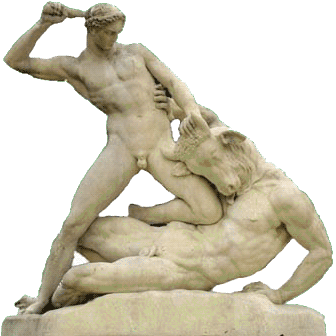
As princes of Crete, Minos and his brother Rhadamanthus fight for the throne. Minos asks Poseidon to send him a bull if it is divine will that he and not his brother should rule. He promises to sacrifice the bull back to Poseidon if it is indeed sent. Poseidon obliges and at the appearance of the divine bull, Minos is crowned King. However, he reneges on his promise to sacrifice the bull. He is enamoured by the bull's beauty and desires it for himself. So he sacrifices another bull in its stead. In anger, Poseidon makes Minos' wife Pasiphae lust for the bull. Easily bent by the god's will, Pasiphae desires the bull more than anything else. She summons the Athenian engineer Daedalus to devise a contraption by which she could copulate with Poseidon's bull. Of this union is born the Minotaur: half bull and half human. Minos now commissions Daedalus to engineer a home for the Minotaur from which the beast could not escape. Daedalus builds the famed Labyrinth of Knossos to keep the Minotaur captive. Now this is where Athens comes in. Minos' son had gone to Athens to participate in an athletic contest and there he was accidentally killed. To avenge his son's death, Minos laid siege to, and captured, the city of Athens and forced the King, Aegeus, to vow to send over 7 youths and 7 maidens to Knossos every 9 years to sacrifice to the Minotaur. Aegeus was compelled to agree lest his city be destroyed. So every 9 years, Athens lost 7 youths and 7 maidens to the Minotaur. It just so happened that the year Theseus came to Athens was a year in which the sacrifice was to be made. Immediately upon hearing about it, Theseus volunteered to be among the unfortunate youths and maidens chosen to travel to Knossos. He planned to free his people from this burden by killing the Minotaur and removing the need for such a sacrifice. From the time he landed at Knossos, the gods were on his side. Aphrodite made Minos' daughter Ariadne fall deeply and irrevocably in love with Theseus (probably via Eros) and Theseus was able to use Ariadne's knowledge and connections in Knossos to plan his success and escape. Ariadne learned through Daedalus that Theseus could escape from the Labyrinth by carrying with him a ball of string which he would unroll as he went along into the maze thus marking his way out to safety. 


Theseus Slaying the Minotaur

Armed with this ingenious exit strategy, Theseus entered the Labyrinth, slayed the Minotaur with his bare hands, and escaped using Ariadne's string. Then he, along with Ariadne and the other Athenians crept to their ship and sailed homeward. On the way, Ariadne was somehow abandoned on the island of Naxos. There are divergent myths about how this came to pass. Some say that Theseus never loved Ariadne and had used her and, when he had no more need of her, he had abandoned her on purpose. Others say that Ariadne had gone ashore on Naxos to collect supplies while Theseus and the crew fixed the mast when a squall of wind blew the ship away from the island and a storm prevented the Athenians from finding their way back. However, both these versions agree that Ariadne was rescued by the god Dionysus who fell in love with her, married her, and took her with him to Olympus. Little remains to be said about Theseus' return journey except the tale of Aegeus' death. When Theseus had first set out for Crete, Aegeus had made him promise that he would change the ship's black sail to a white one on the return trip if his journey had been successful. Now whether because of his grief at abandoning Ariadne or simple forgetfulness, Theseus forgot to fulfil his father's wish and Aegeus, upon seeing the ship's black sail from behind the Parthenon, threw himself from the Acropolis in his grief at losing his son. The sea into which he fell has been known as the Aegean sea ever since.

Tuesday, May 21, 2013

The Impact of the Ancient Greeks

As a student of Classical Civilizations, I study the vast impact that the Ancient Greeks (and the Romans) had on modern society (especially western society). Theoretically, I know that the ancient societies I study continue to strongly influence the world today but practically, my mind still boggles whenever I see something  that is clearly Ancient Greek or Roman play a huge part in the mainstream of today's society.

Take companies and corporations for example. When we think of coffee, most of us think of Starbucks. Next time you're at a Starbucks, take a good look at the seal on the sleeve protecting your hand from the piping hot, delicious latte. The woman in the logo with all the snakes for hair: that's Medusa. We all see Nike products every day but we rarely recognize that the company derives its name from Niké (pronounced NeeKay) who was the Goddess of Victory for the Greeks. Apart from being omnipresent in books, art, television, movies and songs, the Ancient Greek flying horse Pegasus has found itself as the logo/name of thousands of corporations including Mobil, FBR Capital Markets, Pegasus Express Ltd, the UB group, Pegaso, Reader's Digest, Pegasus Airlines, Air France, TriStar Pictures and even Dallas, Texas. Most of us are loyal customers of Amazon.com. Where do you think the name comes from? When we think of the moon landing, we think of Apollo 11. Who do you think that series of spacecrafts was named after? Just do a Google search of Greek influences in industry and you'll turn up an astonishing number of hits. It completely blows my mind.

Don't even get me started on Film and Television. It seems that every second film produced by Hollywood these days is directly influenced by ancient mythology and the rest are indirectly influenced by it. Greek influence in modern music is as surprising as it is extensive. The Greek Epics are ubiquitous in classical music and references to Greek myth in pop music is more common than you'd think. However, arguably the field where classical civilizations have had the greatest impact would have to be literature. A ridiculously high percentage of fiction books produced today draw from the Ancient Greeks. Medieval works of literature, of course, is almost wholly based on Greek or Roman influences. Romantic poetry is famous for being based on Greek mythology. The Classical period of literature is named after the overt classical influences apparent in the literary output of the era. I end with possibly my favorite example: the Bible. The best-selling book of all time tries exceedingly hard not to draw from Greek society but ends up drawing more from it than almost any other book. Just pick up any Dan Brown novel for proof...

Wednesday, May 15, 2013

Classics Audiobooks?

A few days ago  I was just surfing the net (procrastinating) when I came across a link for a set of audiobooks for the Greek and Roman epics. My curiosity prevailed and I ended up buying the Iliad, Odyssey and the Aeneid. I was skeptical. I mean, these are some of the best works of literature ever written and the idea of audiobooks in general doesn't really excite me. For me, the voices in my head that become the various characters in a book are the best part of reading a book and having a voice read a book out to me seems constraining and counter-intuitive and I generally don't enjoy it. Also, the audiobook for the Iliad alone is over 22 hours and I don't know about you, but I think that's a LONG time spent listening to just one voice, no matter how good that voice is. Still, I sat down and listened to book one of the Iliad and I must say, I was a bit won over. I have, I fear, gone over to the dark side. The reader was very skilled and the overall experience was enhanced by sound effects and music enhancing and understating the right bits. I enjoyed it quite a bit.

What do you think? By the way, these audiobooks are all available on Amazon or at audible.com.

Saturday, March 16, 2013

Euripides' Medea: The play and the character: Part 2

Note: This is a continuation of my last post on this blog called 'Euripides' Medea: The play and the character: Part 1'.

The play Medea is a very useful play for classicists as a tool for understanding how Greeks (especially Athenians) viewed foreigners. The protagonist, Medea, is, of course, a foreigner. She's from Colchis which is in modern day Turkey. Jason brought her over from Colchis to Greece during his quest for the Golden Fleece. Perhaps there'll be a post on that adventure on this site sometime in the future. At the time the play was performed, Athens was involved in a long war in which an increasing number of Athenian soldiers were bringing back foreign brides and so sullying the purity of the Athenian citizenship. To maintain the 'Athenianness' of the people of the polis, strict laws of citizenship were put in place. So, the zeitgeist that Euripides was writing for demanded problems in the relationship between Jason and Medea and he was delighted to oblige.

Where we left off last time, Jason and Medea were on Corinth, married and with two sons. Jason was an up and coming figure in the political circles of Corinth and, in order to gain more power, he agrees to marry Glauce, the daughter of Creon, the king of Corinth. Technically, in doing so he breaks his sacred marriage vows with Medea and so should draw the wrath of the gods. However, since Medea is a foreigner, Euripides seems to imply that it's ok for Jason to divorce her without any divine repercussions  He does still have to face human repercussions though, as we shall soon see. Medea, of course, is not thrilled by the turn of events and, in a fit of anger, threatens Glauce if she proceeds with her marriage to Jason. In order to protect his daughter, Creon decrees that Medea and her sons with Jason are exiled from Corinth. It is at this point that the play opens, with the nurse of Medea summarizing these events for the audience.

Medea is distraught at Jason's betrayal. She cannot stand idly by and be toyed with. She is one of the most powerful characters in ancient Myth and the audience at the time must have known that. Euripides has built a tantalizing foundation for his play. We have the hero who betrays the powerful foreign sorceress in favour of the beautiful, young princess. Now he makes the hero come to the sorceress and defend his actions. Euripides' Jason truly seems to believe that he has not betrayed Medea but done the right thing by her. He says that he had courted Glauce in order to gain power so that he could protect Medea and their children and provide safe, happy lives for them all. He blames their current plight on Medea. Why did she have to go and threaten the royal family he asks. Why couldn't she just keep her temper in check and just keep silent? Well, since her mindless actions have brought ruin upon her, he says, he is prepared to extend his help for her and the children during their exile. He offers to provide wealth and organize sanctuary for Medea and his sons. Medea, of course, refuses.

What follows is one of my favorite give and takes in Greek Tragedy. We learn an incredible amount of the myth of the Golden Fleece hunt from the following speeches of Medea and Jason. We also learn a great deal about the 'proper' role of women in ancient Greece and the dichotomy of gender roles in society. Succinctly put, Medea alleges that Jason would not have survived his adventures without her help. She lists all the things she has done for him and indeed, it is a long list. She accuses his of forgetting what he owes her and deserting her out of passion for a younger woman. Jason, in response, states that all Medea had done for him were not done by her own free will but the will of the gods. He was not indebted to Medea for his survival and success but to the Olympians who watched over him. He reminds Medea of the favours he has done for her in return. He reminds her of the fame, wealth and power he has given her. He then refutes her accusation that he was in love with Glauce and had left Medea out of blind passion. Blind passion, he says, are for women. Men are practical beings. This gives us a glimpse into the minds of the ancient Greeks when it came to defining gender roles. Jason goes on to explain how his marriage to Glauce would have benefited Medea and her sons if only she had held her tongue. He reiterates his offer of help. Medea, stung by his words and driven by her pride, refuses his offer and bids him to leave her and return to his young new bride.

Medea wants revenge. She burns with her desire for revenge. She is a very dangerous woman and she seeks to destroy the lives of Jason and the Corinthian royalty. She comes up with a plan that in my eyes has to have been one of the evillest ever plotted.

First, Medea secures her own future. She meets with Aegeus, king of Athens (and father of Theseus) and organizes sanctuary for herself in Athens. Then, she pretends to have made peace with the decisions of Jason and Creon. She sends her children with gifts as an offering of peace to Glauce and Creon. Her sons present Glauce with a beautiful robe and an even more dazzling diadem. Here begins Medea's systematic destruction of Jason's life. When Glauce puts on her new robe and diadem, her skin starts burning as if by acid and her hair catches on fire. Her eyes pop out and she screams in agony! The gifts were laced with a potent poison (the same one used to 'kill' Heracles). In an attempt to help his daughter, Creon pulls her to him and brings himself under the influence of the poison as well. The two perish in utter agony. Step one of Medea's revenge is complete: She has destroyed Jason's new life in Corinth and, in the process, destroyed the Corinthian royalty that had dared to exile her.

The next part of the play is a sad one and shows the lengths to which Medea (who represents the 'barbaric' outsider) would go to avenge a wring done to her. She kills her own children. There is a gut-wrenching scene in the play where she steels herself for the task while to chorus of Corinthian women beg her not to go through with it.But she does, and in doing so, she deprived Jason of his sons and the future of his lineage. His new wife is dead and his children with his ex-wife are also gone. He is left with the ignominy of knowing that his line ends with him. In ancient Greece, this was ignominy indeed. Ensuring the longevity of one's lineage was a duty demanded by the gods in ancient Greek society. By failing at that task, Jason has made himself a pariah and all his past success as a hero dims in comparison with his failure at his basic human duty. To complete her revenge, Medea takes the bodies of her sons with her when she escaped (on a dragon-drawn carriage provided by Helios! Wicked!) and went to Athens. In doing so, she deprives Jason of the chance to give his sons a proper burial, horrifying for any ancient Greek father.

Medea's revenge was complete. She goes on to feature prominently in the myths of Athens and Theseus but that is a tale for future posts to tell.

Euripides' Medea is a truly fascinating play with one of the most complex (and my favourite) tragic character.

Sunday, December 16, 2012

Euripides' Medea: The play and the character: Part 1

33 tragedies survive from ancient Greece. 7 of these are the work of Aeschylus, 7 Sophocles and 19 Euripides. Of the 19 Euripides tragedies that have survived completely (well, almost), my favorite is 'Medea'.

Perhaps I like this play the best of all Euripides' work because I like the character of Medea the best of all the characters that Euripides employs. I liked her character a whole lot in classical myth before I even read the play. She is, in my opinion, one of the most dynamic, complex and multifaceted characters in classical myth and that's saying a lot. Unpredictable as the ocean, fickle as the winds, with the power of the sun and the beauty of the earth: the elements that combine to make Medea do so generously.

Euripides

In myth, Medea is the granddaughter of Helios, the god of the sun. She was a witch, which in ancient Greece meant that she had supernatural powers that allowed her to control things that humans generally could not. On a list of the most powerful/dangerous witches of classical myth, Medea would be second only to Circe, who I might discuss in a later post (she is almost as fascinating as Medea). Key to the ancient Greeks was the fact that she was what they called a barbarian, i.e. a non-Greek. She was from the far shores of the Εϋξεινος πóντος (the friendly sea) which was what the Greeks called the Black Sea. Her story is tied the that of Jason (Jason of Jason and the Argonauts) and that is far too long a story to go into now. I'll talk about it in my next post. Long story short, Jason and Medea fall in love and Jason brings Medea back to Greece with him.

By the time the play 'Medea' begins, Jason and Medea have two sons. However, all is not right with their lives (and that's why it's a tragedy).

The play is set in Corinth, a city in ancient Greece. At the opening of the play, Jason has left Medea for Glauce, the daughter of Creon, the king of Corinth. Medea, of course, is distraught and furious. In her fury, she has threatened Glauce and, fearing for the safety of his daughter, Creon has banished Medea and her children from Corinth. Jason defends his actions by insisting that marrying Glauce was the right thing for him and for their family. He says that his marrying the daughter of the king of the land would have served to secure their future if only Medea had acted sensibly. Now, because of her rash actions, he says, she is banished along with her children. He offers to help her seek shelter in another part of Greece but Medea is in no mood to accept any help from him. She yells at him for abandoning her and their children and insists that his decision was made with only self gain in mind. Frustrated, Jason leaves her. Medea vows to have her revenge...and she does. What does she do? Find out in part 2! (Oh, that rhymes!)

Wednesday, April 11, 2012

Heroes

Heroes. What exactly are they? More to the point, what were they to the ancient Greeks? If I was an ancient Greek, what image would my mind conjure when I heard the word 'hero'?
Unfortunately we do not have an ancient Greek brain to pick and so we have to look to archaic written sources. In Hesiod's Works and Days we find a reference to what the heroes were to the ancients. Hesiod tells us that men were created as five successive races (to date) and the current crop of men were of the fifth or iron race. The four preceding races (or ages) were the golden race, the silver race, the bronze race and the race of heroes. So by Hesiodic definition, heroes were the race of men that preceded the current Iron race of men.

Today classicists define a hero as any larger than life figure who has, or at one point had, an active localized cult. Basically, in ancient Greece, each hero had his/her own localized cult and all who pass through the land and past the cult would have to pay homage to the figure of the hero. So all the great heroes that we talk about today, like Perseus, Atlanta, Theseus, Achilles, Diomedes and the like, would have had their own localized cults in ancient Greece and this is what made them heroes.

An interesting case of a hero would be that of Heracles. Heracles was undoubtedly a hero of great significance. He traveled all over the ancient Greek world doing heroic things and killing all sorts of things. The problem arose when because of this travelling, and his stature, cults in his name sprung up all over Greece and beyond. He could no longer be strictly defined as a hero because his cult wasn't localized . So the Greeks elevated him to the rank of a god to explain his large following and this is why Heracles often exists in the dual roles of hero and deity in ancient Greek sources.

Tuesday, April 03, 2012

Goat songs and Revelry songs

The most unfortunate fact that students of Classics have to face is that there are no ancient Greek bards wandering around singing about the gods anymore. What we know about Greek myth, culture and society is not first hand knowledge. Part of it is gleaned from the songs sung and tales told by small populations in parts of Europe that still follow the oral tradition. They heard what they sing today from their parents and their parents heard it from theirs before them and so on. The stories that one can hear from them, if one is privileged enough to be invited to such a gathering, can be traced back to the time of the ancient Greece aoidoi. However, the problem with the information learned by the oral tradition is that we really don't know how trustworthy it is and so Classicists always double check their findings. The overwhelming majority of what we know about ancient Greek culture and myth we know from reading ancient texts and, far more often, fragments of ancient texts that have somehow survived through the ages.

Ancient Greek sources (texts) are many and varied. The type that we will be dealing with today is Drama. The ancient Greeks pioneered the Dramatic arts and the plays that survive today are treasure troves of information.

The popular portrayal of Comedy and Tragedy
Image credits: www.fanpop.com


The two types of drama in ancient Greece were Tragedy (literally goat-song) and Comedy (fun-song or revelry-song). These two genres can only very loosely be grouped together since they represent forms of art that are complete polar opposites of one another in terms of form, content and intent. Tragedy is the more ancient and revered form; Comedy was born much later and served a very different purpose. Tragedy was born simply to honour the gods. All tragedy and tragic poetry involved the gods and many of them involved heroes. Through tragedy, the Greeks acknowledged the existence and potency of a power that they could perceive but not comprehend. Almost all the examples of ancient Greek tragedy that have survived portray people as helpless in front of mighty, omnipotent deities that always have their way in the end.

The role of comedy was very different. Comedy basically existed to insult. It's purpose was to point out flaws and shortcomings in people, groups or systems so that they could be fixed. In this role, it must be admitted that Comedy was very successful indeed. In ancient Athens, especially, Comedy was a very powerful medium of communication and several heads rolled because of what Comic poets wrote.

Tragedy and Comedy share one characteristic though: they were aimed at an audience. Due to this simple inherent quality, they are invaluable for Classicists trying to piece together the image of the society and culture of the times. Because drama was aimed at an audience or, otherwise put, designed for an audience, it is fraught with information about the era and allusions to popular beliefs. Through ancient Greek drama, one can perceive the zeitgeist of ancient Greece.

Therein lies the importance of goat songs and revelry songs.

Saturday, October 15, 2011

The great Heroes before the Trojan War


The Trojan War produced the many of the greatest heroes that classical mythology boasts of. The lives and exploits of these heroes have been well documented and romanticized by many a poet and bard over the years and now with the release of movies such as TroyTM and the like there are few people across the globe who do not know the names of Achilles, Hector, Odysseus, Paris, Ajax, Agamemnon and so on and so forth. However there was another crop of heroes, just as famous, of an ilk arguably far superior to that of the illustrious heroes mentioned above. These heroes existed before the Trojan War had ever begun. There are several great heroes before the Trojan War but undoubtedly the four greatest are, in chronological order, Perseus, Heracles, Atlanta and Theseus. The latter three were of the same generation: the one immediately preceding the Trojan War. Atlanta and Heracles partook in the Quest for the Golden Fleece together and Heracles and Theseus were compatriots in several adventures and shared the bond of blood…but more on this later.

Perseus was several generations before the other three. In fact, he was the grandfather to Heracles. The adventures of Perseus are the subject of numerous books and discussions but I can give a condensed form here…

Friday, August 05, 2011

The two great Gods of the Earth...Part 2


Demeter, to recapitulate, was the Goddess of the corn. She was a daughter of Cronus and Rhea and sister to Zeus, Poseidon, Hades, Hera and Hestia. This made her an Olympian by birth but she was not held to be an Olympian by the Ancient Greeks. She was a Goddess much more often found on earth than in Olympus. Demeter was a peoples’ deity. She helped the women as they sowed the seeds. She held the hands of the farmers as they harvested the corn. She was the Goddess who allowed the Greeks to live, to sustain. She did not make any extravagant demands. She asked for no great sacrifice. The simple thrashing floor was held to be her temple, the mere act of breaking corn-bread an offering to her. She was thus a more personable and real Goddess than the Olympians. The Greeks felt her presence in everyday life; they were directly affected by her power.

Another fact about Demeter that drew the Greeks closer to her was that she was a Goddess who knew real suffering. She had experienced doom and despair and fear and other human emotions that Gods and Goddesses were usually immune to. Demeter and Dionysus, the two Gods of the Earth, were held to be suffering Gods and thus in a class by themselves among the divinities.

The source of Demeter’s great suffering was her daughter, Persephone (Proserpine in Latin).   Persephone, being the daughter of the Goddess of corn and agriculture, was the Goddess of flowers. She and her handmaidens often went out in search of new and lovely flowers, roaming the Greek countryside in search of the wonderful blooms. When she was on one of these outings, she was sighted by Hades, the Lord of the underworld. Hades fell in love with her and sought to have her as his own. To this end he went to his brother, Zeus, and asked him for help in making Persephone his bride. Zeus created a beautiful flower, far beautiful than any other flower in existence, and made it bloom some distance away from Persephone and her handmaidens. The Goddess noticed it and was entranced by the lovely flower. She could not help but approach it and as soon as she was separated from her handmaidens Hades caused a chasm in the earth and flew up in his chariot. He grabbed Persephone and before her handmaidens could do anything but scream in horror he had descended below ground leaving no trace of his presence at the site.

Upon hearing of her daughters disappearance Demeter was devastated. She searched the earth and heavens for Persephone but could not find her anywhere. She sunk into a deep depression and wandered from place to place, not eating or drinking, just looking desperately for her daughter. The effect of her gloom was devastating upon the earth. The ground bore no fruits or flowers and became hard and parched and lifeless. Crops died and all humanity suffered terribly from starvation and thirst. Zeus sent emissary after emissary to talk to Demeter but she could not be appeased. She pined for her daughter and all creation suffered along with her. As her state worsened so did the condition of the earth and men and Gods alike. The warm and moist fields were replaced with dry, unyielding deserts. Trees began dying, ponds and lakes evaporated and breezes stopped blowing. All this time Demeter sat and brooded over Persephone’s disappearance.

Finally Zeus realized that there was only one solution to this terrible problem and he commanded Hades to release Persephone. Hades had no choice. He had to follow his brother’s order but he did so with an ill will and concocted a plan which would mean that he did not permanently lose his bride. He convinced Persephone, who longed for her mother as her mother longed for her, to consume a pomegranate seed before she ascended to Earth. He knew that this would ensure that Persephone would have to return to him for a large amount of time every year. So Persephone returned to Earth and was reunited with her mother and Demeter rejoiced at getting her daughter back though she despaired when she heard of the pomegranate seed. Still, Demeter got her daughter back and the earth became fertile again and the ground yielded bumper crops for several seasons to come.

However Demeter’s joy was not complete. Persephone was compelled to return to the underworld as Queen for four months every year. So Demeter suffered every year as she saw her daughter basically die every year. The fun-loving Goddess of flowers too was never the same again. She was the flower Goddess but she was also the Queen of the underworld for a third of the year every year. She was now a terrible Goddess; a Goddess of life among the dead; the Goddess who died every year. And every year when she died Demeter pined for her and the earth grew cold and unyielding until she came back four months later and brought spring and joy and happiness with her. That is how the Greeks explained the phenomenon of winter!

Saturday, July 02, 2011

The Olympians...Part 5

Zeus had a single child with Maia. This child was Hermes, God of thieves, tricksters and travelers. He is a wily Goddess, always up to some trick or the other. He was the messenger of Zeus along with Iris, Goddess of the Rainbow. His duties also included leading the souls of the dead to the underworld where they were to remain for all eternity. Hermes is the God most familiar to us. He appears oftener than any other divinity in Mythology. He is described and a "lovely youth at that time in his life when youth is at its loveliest." Various statues and sculptures throughout history have ensured that we all know what Hermes looks like. He is always pictured with a winged hat, winged sandals and his staff called the Caduceus.

Last but not least is Aphrodite, the laughter loving Goddess of beauty and physical love. She is sometimes said to be a child of Zeus but she is more commonly said to have risen out the foam created when the bits and pieces of Ouranos' body fell into the sea. Certainly her name seems to concur with this version: Aphros means foam in ancient Greek. From the spot where she was formed Aphrodite was said to have floated to the island of Cyprus where the seasons nursed her and took care of her. She is often portrayed with Eros (Latin Cupid), God of love, who is sometimes her son and sometimes her companion.

So these are the Twelve Great Olympians: Zeus, Hera, Poseidon, Hades, Hestia, Apollo, Artemis, Ares, Athena, Hephaestus, Aphrodite and Hermes.

The Olympians...Part 4

Zeus had two children with a Goddess called Leto. They were twins: Apollo and Artemis. Apollo was the God of many things. He was the God of music, who entertained all of Olympus with his Lyre. He was the God of medicine and the patron of all healers. He was the God of Archery who never missed his target. He was the God of truth and a lie never crossed his lips. He was the God of poetry and would spout the most beautiful verses at random times. He was the God of oracles and his priestess at the temple at Delphi would answer honestly every question put forth to her. In later hymns he is confused with Helios, the God of the Sun though the two should never be held to be the same. His sister Artemis was another complex being. She was the Goddess of the hunt, a strange office for a woman. Like all great huntsmen she protected the young and was thus held to be the Goddess of youth and innocence. She was the Goddess of the wild and nature and animals were under her special care. She, along with Hestia and Athena, was a virgin Goddess and her priestesses were all maidens, protected from the corrupting nature of the free world. If her brother was confused with the sun God, she was mistaken for Selene, the Goddess of the moon. Tales of the underworld show her in a very different light. In the darkness she was Hecate, Goddess of witchcraft and magic and the evil crossroads. So we see Artemis as a three faced Goddess: innocent Goddess of the wild and the young on earth; delicate Goddess of the dark side of the moon in the sky and dark Goddess of magic and evil trickery in the Underworld. Artemis, more than any other Olympian, shows us the danger of mixing and matching myths and divinities in Mythology.

The Olympians...Part 3

Zeus and Hera had two children: Ares and Hephaestus. Ares was the God of War: an inexorable and terrible God who slept on the skins of the men he killed and spread discord and pain wherever he went. On the flip side of the coin he is also sometimes held to be the patron of heroic deeds and valiant acts of war. Hephaestus' story is an interesting one. He alone of the Gods is not perfectly formed. He is a deformed and cripple God and Hera, the Goddess of family herself was repulsed to see him when he was born. He was thrown from Olympus from whence he fell nine days and nights till he reached the earth. By the time the Iliad is written, however, Hephaestus is back on Olympus and is indeed a very important divinity: the god of fire and mechanical creation and invention. He is the blacksmith of the Gods and keeps their armour as well as their domestic metalwork in shape.

Zeus alone gave rise to Athena. She is said to have "sprung from his head in full armour." She is Zeus' favourite child and the most trusted Olympian, by men and Gods alike. She is the only one who is allowed to carry Zeus' master bolt and his shield: the terrible Aegis. She is most often referred to as the gray eyed or stormy eyed goddess. Athena is a complex concept to swallow. She was a warlike Goddess yet not the Goddess of war: that was Bellonna. She was the Goddess of arts and crafts and a patron of tradesmen. She was the protector of cities and the urban way of life. Most importantly she was the Goddess of wisdom: the all knowing Goddess and the strategist of the Gods.

The Olympians...Part 2

The Twelve Great Olympians were Zeus, his brothers and sisters and his children. Cronus and Rhea (Zeus' parents) had six children: Zeus, Poseidon, Hades, Hera, Hestia and Demeter. The three brothers i.e. Zeus, Poseidon and Hades, drew lots for the control of the separate parts of creation. Hades became the Lord of the Underworld, Poseidon gained power over the Oceans and Zeus got overall control and became Lord of the Heavens. Zeus and his sister-bride Hera were named King and Queen of Olympus and all creation. Hera was the Goddess of family and married women. Hestia was the Goddess of the hearth who protected both the home and the city. Her name was taken at the beginning and end of each meal and every city had a central fire which was tended by maidens dedicated to Hestia. Care was taken that the fire never went out because such an occurrence spelled doom for the city and its inhabitants. Whenever a new city was to be founded, smouldering embers from the hearth of the mother-city were used to start the fire in the new city. Demeter was the Goddess of Corn and a central figure in day to day activities. Though an Olympian by birth, she was oftener to be found on earth and is thus not regarded as an Olympian but as a Great Goddess of the Earth.

The Olympians...Part 1

The Greek divinities were complex and intricate beings. Before the Greeks came around, the powers which controlled the universe were shadowy, mysterious beings; never defined, never described and never seen or heard though their effects were felt. Yes there was a someone who caused it to rain and yes there was a certain entity who pulled the vast ball of fire across the firmament but they were shapeless, formless creatures about whom the people had no idea. When the Greeks came along they decided to personalize the powers that controlled their lives: to give each a shape, a form and a distinct personality. They decided that the powerful ones were human in form: perfect examples of humanity. They imagined such a being in everything they saw: the earth was no longer the ground upon they stood but was instead Gaea, the mother of all creatures and all things. The sky was no longer a vast emptiness but Ouranos: the one who enveloped Gaea and all creation. Trees became Dryads and Hamadryads; lakes and streams contained beautiful Nymphs and water-deities; thunder and lightning were caused by Zeus' master bolt; earthquakes and storms by Poseidon's Trident; volcanoes were Hephaestus' workshops, winds blew when commanded by Aeolus and so on and so forth.

The Gods and Goddesses, as mentioned above, were given distinct personalities. At first they were shown to be perfect: the epitome of humanity. By the time the Homeric Hymns were penned, they had developed unique weaknesses, just like people. The ancient Greeks were gradually fabricating divinities in their own image.

The major divinities were called the Twelve Great Olympians. They resided on Mount Olympus, sometimes held to be an earthly mountain but usually regarded as a mystical land high in the heavens, separated from the earth by vast stretches of emptiness. The gates of Olympus were guarded by the seasons who were under the overall command of Zeus.

Friday, July 01, 2011

Real cause of the Trojan War...

I had always thought that the blame for the Trojan War could be put squarely on the shoulders of Eris, the Goddess of Discord. At the marriage of the Nymph Thetis to the Peleus, King of Aegina, (the parents to Achilles) all the Gods and Goddesses were invited except for one: Eris. In her anger at this insult, Eris appeared at the wedding feast and threw an apple into the room before vanishing in a cloud of smoke. On the apple was inscribed: 'For the Fairest'. Of course all the Goddesses wanted to be crowned the Fairest but in the end the competition was narrowed down to three: Hera, Queen of Olympus; Athena, Goddess of Wisdom, Trade and the City; and Aphrodite, Goddess of Love and Laughter. The trio stood before Zeus, King of the Olympians, and asked him to adjudge who the most beautiful Goddess was. Zeus was now stuck between two rocks and a very hard place...any decision he made would be sure to cause bitterness and rivalry in his family. So, wisely, he refused to be the judge answering instead that there was one man, a mortal, who would be able to correctly choose the Fairest. This man, he said was Paris (or Alexandrius), son of Priam who was the King of Troy. The night Paris was born a soothsayer told the king that the boy would one day cause the destruction of Troy so the king told one of his attendants to make sure the boy never saw the light of day.The attendant, being a kindhearted man, could not bear to kill the child so instead he left the boy on the summit of Mount Ida where he would, no doubt, freeze to death. However that very night a kindly goatherd found Paris and brought him up as his own son. So at the time of the wedding of Thetis to Peleus, Paris was a grown man, a goatherd on Mount Ida. The three vying divinities went to him and asked him to cull out the fairest among them. Each promised a wondrous gift if she was selected: Hera promised that he would be a king of an empire and would have enormous wealth; Athena promised him great prowess in battle; and Aphrodite promised him the most beautiful woman in the world as his bride. Paris chose Aphrodite, thus incurring the undying wrath of Hera and Athena and the faithful affection of Aphrodite. The most beautiful woman in the world was Helen, daughter of Zeus, and years later Helen eloping with Paris would cause the Trojan War.

However recently I read a book which stated that the blame for the Trojan war should go to Prometheus, not Eris. Thetis and Zeus were at one point lovers. Prometheus foresaw that the son of Thetis would be far greater than his Father. Zeus immediately abandoned Thetis and arranges her marriage with Peleus. If the marriage had not occurred, the book argues, then Eris would not have been angered and the long train of events that caused the Trojan War would not have been triggered!

What do you think?